
105 Ocoee Street · Built 1946–1947
On the Border of Two States
Late one Saturday morning in the late 1940s or ’50s, the sound of piano scales echoed from an open second-floor window above Richard Jabaley’s store at 105 Ocoee Street, Copperhill, Tennessee. One of the building’s six upstairs apartments was home to a music teacher who offered lessons to families throughout the region. Hour after hour, students took their turn at the keys of a grand piano — a piano that somehow found its way to a second-floor apartment, leaving townspeople to quietly wonder how it ever got there. In those simpler times, lessons often ended with a walk across the street to Daves Drug Store for a grilled cheese and a Coke.
That piano and those stumbling scales are a perfect emblem of what the Jabaley Building has always been: not just a commercial address, but a living piece of community life. In the post-war optimism of 1946, Richard Jabaley Sr. — a second-generation Lebanese American who had come to Copperhill from Marietta, Georgia — broke ground on a commercial and residential building that would become one of the most uniquely situated structures in the American South. Constructed at 105 Ocoee Street in Copperhill, Tennessee, the building straddles the exact painted boundary — known as the Blue Line — that separates Tennessee from Georgia. Its distinctive yellow brick front facade still marks the corner today.
Completed in 1947, the structure’s ground floor housed Richard Sr.’s own clothing and dry goods store, while the upper floors contained five spacious apartments with ten-foot ceilings and one smaller corner unit — home at various times to music teachers, dentists, chiropractors, insurance agents, newlyweds, and the family’s own children.
The building has been home at various periods to a craft brewery, a mountain outfitter, antique shops, a candle company, and furniture stores. But its deepest story is the human one: of an immigrant family that crossed an ocean, walked hundreds of miles selling dry goods, and ultimately built something enduring — in yellow brick, on a border, in the mountains of Appalachia.
A Building on the Border of Two States
The blue line painted on the street divides the state of Georgia to the left and Tennessee to the right, and passes right through the Jabaley building with its distinctive yellow brick front facade. This quirk of geography means a visitor can stand inside the building with one foot in each state — a novelty that has long made the Jabaley building one of the more memorable landmarks along Ocoee Street.
The Store, the Apartments, & the Piano
Richard Jabaley Sr.’s store on the ground floor of 105 Ocoee Street was a full-service retail establishment in the tradition of the era. It carried ready-to-wear clothing for all ages — men’s, women’s, and children’s — along with shoes, work clothes, household goods, and millinery. For those who sewed their own garments, there was a well-stocked fabric and notions section. Tires were sold from a balcony area. Richard Sr. and his wife Minnie both worked in the store daily, and as their sons Richard Jr. and Ronnie grew older, they joined in as well.
The building’s construction required creative problem-solving from the start. Richard Sr. had the basement excavated four feet deep and filled with scrap metal to prevent seepage from the nearby river and to add stability to the foundation — a practical solution befitting a builder who understood both the site’s geography and its industrial surroundings.
The split geography of the building created real-world complications that went beyond photo opportunities. When the building was completed, tax officials asked Richard Sr. in which state he wished the store to be designated for property taxes. His answer was Tennessee. While that settled the matter for him personally, the building’s dual-state footprint later created headaches for subsequent owners. One former accountant recalled the extra work involved in filing sales taxes for two states. Furniture store owners later joked with customers about which door they preferred their purchases to exit — since Tennessee and Georgia carried different sales tax rates.
Upstairs: A Neighborhood Unto Itself
The five spacious apartments and one smaller corner unit — all with ten-foot ceilings — functioned as a vertical neighborhood. Over the decades, the upstairs was home to a remarkable cast of tenants:
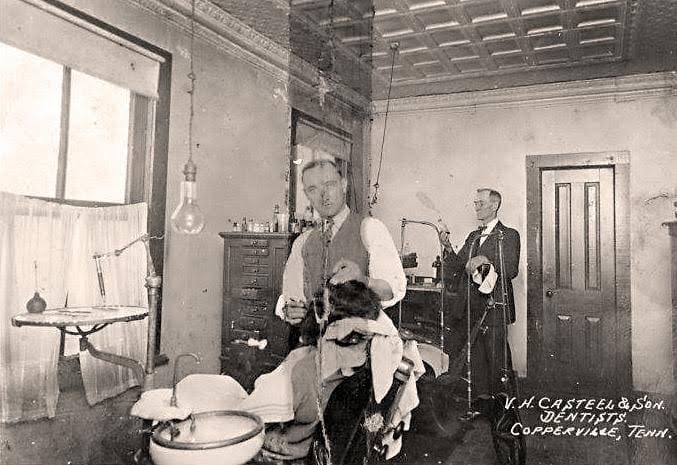
Dr. Claude H. Casteel (1900-1968) in the front and his father, Dr. Van D. Casteel (1857-1955) behind him in their upstairs dental office
The apartments were especially well-suited for young couples starting out. Richard Jr. and his new bride Kathy moved into one in 1961 and lived there for eleven years, raising their children in those high-ceilinged rooms before eventually building a home in Epworth. Later, younger son Ron Jabaley and his wife Kay also began their married life in one of the building’s apartments after returning to the community.
Richard Jr.’s rear apartment doubled as a photography studio. He was widely respected throughout the region for his work, specializing in weddings, engagements, family portraits, and sports photography. A familiar sight on Friday nights, he walked the sidelines of high school football games to capture action shots — images that still appear in family albums across the Copper Basin today.
A Border Unlike Any Other
The Tennessee–Georgia state line that runs through the twin cities of Copperhill, Tennessee and McCaysville, Georgia is one of the most unusual borders in the United States. Rather than following a river, a ridge, or an open field as most state lines do, this boundary cuts diagonally right through the middle of a shared downtown — slicing across streets, through buildings, and past storefronts.
The Blue Line
The boundary has been in dispute for years, and even the famous blue-painted stripe along the pavement is not considered entirely definitive by modern surveyors. The line’s peculiar routing through downtown is traced to an 1819 surveying expedition: officials were instructed to follow the highest ridges to the Georgia state line, but at Unicoi Gap, surveyors reportedly turned south for 15 miles because they had run out of provisions and heard of a moonshine still at the Georgia border.
The Jabaley Building sits directly on this painted blue line. Homes and businesses on the Copperhill side carry Tennessee’s 423 area code; those on the McCaysville side use Georgia’s 706. It is entirely possible — and common — for a building’s front door and back wall to be in different states.
How was the state line originally established?
In 1819, state surveyors were instructed to follow the highest ridges toward the Georgia border. At Unicoi Gap, however, they abruptly turned south for approximately 15 miles, reportedly due to a shortage of supplies and the lure of a nearby moonshine still at the Georgia line. This deviation created the diagonal cut that would define the shape of the border for centuries — and produce the unique spectacle of a state line running through a shared downtown.
What makes the Jabaley Building's location uniquely remarkable?
The building sits directly astride the Blue Line, meaning portions of the structure are technically in two different states. For a period, Copperhill Brewery operated from these premises, promoting itself as the only place in America where you could enjoy craft beer while standing in both Tennessee and Georgia simultaneously.
What other famous buildings are nearby?
Copperhill’s City Hall, built in 1925 by the Tennessee Copper Company at the corner of Grande Avenue and Main Street, originally served as a YMCA building. It is a prime example of Colonial Revival architecture and was listed as a contributing resource to the Copperhill Historic District on the National Register of Historic Places in 1992. Also nearby, the Riverwalk Shops (in McCaysville, GA) once housed the A&P Grocery Store, Williamson 5 & 10, Hampton Hardware, and John Jabaley and Sons Clothing Store, which opened in 1949 — another branch of the same Jabaley family enterprise.
A Century of History
From copper strikes to post-war construction to lotion candles, the story of the Jabaley Building is inseparable from the broader story of Copperhill.
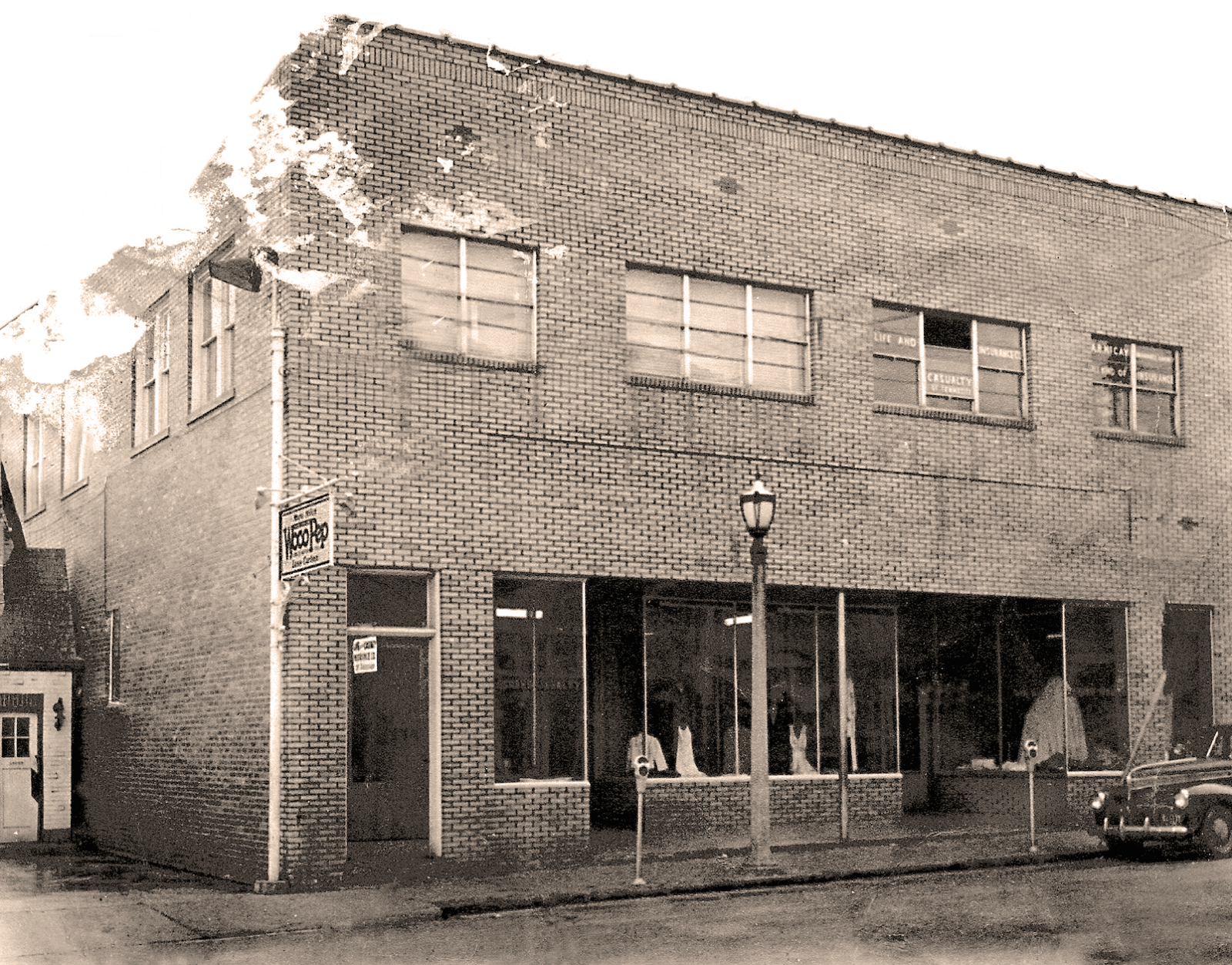
Richard Jabaley’s Store - c. 1950
Copper Discovered in the Basin
A prospector searching for gold near present-day Ducktown, Tennessee instead uncovered brilliant red crystals later identified as copper ore. The discovery launched a mining rush that would transform the entire region. Within a decade, more than 30 mining operations had sprung up across the basin, and the once-quiet Cherokee homelands had become a hive of industrial activity. The Cherokee themselves had been removed in the Trail of Tears just five years earlier, in 1838.Environmental Devastation Peaks
By this year, approximately 50 square miles of the Copper Basin had been stripped of all vegetation. Mining companies used open-roast heap smelting — essentially building enormous bonfires of ore — which produced sulfuric acid gases that acidified rainfall and prevented vegetation from regrowing. The topsoil, no longer held in place by roots, washed away, leaving behind a barren Martian landscape of red clay that earned the region national notoriety as the largest man-made biological desert in the country.Tennessee Copper Company Establishes Copperhill
The Tennessee Copper Company (TCC) consolidated most mining operations in the basin and constructed a major new smelter at the town of McCays (soon to be renamed Copperhill). The town grew rapidly as a company headquarters, drawing thousands of workers and their families. By 1904, TCC had placed its full corporate headquarters in Copperhill, making the small mountain town an unlikely center of American heavy industry.McCays Renamed Copperhill
When the Louisville & Nashville Railroad consolidated its two nearby stations, it renamed the combined depot "Copper Hill." The city of McCays, Tennessee followed suit and officially became Copperhill — cementing a name that would endure through the decline of mining, floods, and economic change into the 21st century.Downtown Infrastructure Matures
The 1920s and '30s saw significant investment in Copperhill's downtown. The iconic steel truss bridge (originally built 1920–21 over the Toccoa River in Morganton) was moved to its current span across the river in 1936, at the same time a concrete bridge was constructed. The Tennessee Copper Company built the YMCA (now City Hall) in 1925. A drug and confectionary store opened on Grand Avenue. The Blue Line was painted on the pavement, becoming one of Copperhill's signature landmarks.Reforestation Begins
The Tennessee Valley Authority (TVA) partnered with the Tennessee Copper Company on a long-term reforestation project for the denuded Copper Basin. This was one of the earliest and most ambitious reclamation efforts of its kind in American industrial history. The effort, later supplemented by private investment and EPA oversight, would eventually restore the basin to a thriving forested ecosystem — though full recovery took until the 1990s and beyond.Wartime Acid Plant Construction
World War II brought a surge in demand for industrial chemicals, and TCC constructed a major sulfuric acid plant in Copperhill. By this point, sulfuric acid had become more economically important than copper itself — an ironic transformation of the region's identity. This wartime industrial expansion created the prosperous economic backdrop against which Richard Jabaley would build his landmark commercial building just four years later.Richard Jabaley Sr. Constructs 105 Ocoee Street
Richard Jabaley Sr., a second-generation Lebanese American from Marietta, Georgia, purchased a lot at 105 Ocoee Street and began construction in 1946. The building was completed in 1947. Its basement was excavated four feet deep and filled with scrap metal to prevent seepage from the nearby river. The distinctive yellow brick facade fronted a ground-floor clothing store and six upstairs apartments (five spacious, one small corner unit) with ten-foot ceilings. The Georgia-Tennessee state line bisected the building; when tax officials asked Richard Sr. in which state he wished it designated, he chose Tennessee.John Jabaley & Sons Clothing Store Opens (in McCaysville, GA)
Two years after Richard Sr. completed 105 Ocoee Street, the broader Jabaley family opened another clothing venture — John Jabaley and Sons — in the Riverwalk area of downtown. This established the family as twin pillars of Copperhill's commercial district during its post-war peak. The Riverwalk buildings also housed an A&P Grocery, Williamson 5 & 10, and Hampton Hardware, forming a vibrant commercial corridor along the river.Richard Jr. and Kathy Move In
Richard Joseph Jabaley Jr. and his new bride Kathy moved into one of the upstairs apartments at 105 Ocoee Street in 1961. They lived there for eleven years, raising their children in those high-ceilinged rooms above the family store, before building a home in Epworth. Later, younger son Ron Jabaley and his wife Kay also began their married life in one of the apartments. The building was home not just to a business but to the family itself across two generations.Richard Sr. Dies; Richard Jr. Takes Over
Richard Jabaley Sr. died in 1981 after managing his store at this location for thirty-seven years. His son, Richard Joseph Jabaley Jr., returned home and took over operation of the building and business. Richard Jr. also maintained a photography studio in the smaller rear apartment, specializing in weddings, engagements, family portraits, and sideline sports photography — a well-known figure at regional high school football games.Copper Mining Operations Cease
After over 140 years of mining, the last copper operations in the basin closed. The Tennessee Copper Company, which had for decades been the economic heart of Copperhill and the surrounding region, wound down. Most of the industrial plant infrastructure was eventually sold overseas for scrap. The closure forced the twin cities to reinvent themselves — a slow, difficult process of economic transition toward tourism, outdoor recreation, and heritage tourism that would reshape Copperhill's identity.Store Closes, Then the Great Flood
The decision to close the Jabaley clothing store was made in early 1989 — a direct casualty of the massive staff reductions at the mining operations. Though the mines themselves had closed, acid and chemical production continued, leaving a fraction of the workforce that once supported the local economy. A going-out-of-business sale was already underway when, in the early morning hours of February 16, 1990, a catastrophic flood struck Copperhill and McCaysville, damaging 90% of the shared business district. Floodwaters reached 8 feet in depth along Ocoee Street, reaching the second stories of many buildings. After extensive cleanup, Richard Jr. managed the building as a rental property until selling it in 1998.Copperhill Historic District Listed on National Register
The Copperhill Historic District, including the Jabaley Building and other downtown structures, was listed as a contributing resource to the National Register of Historic Places. This recognition formalized the architectural and historical significance of the downtown core and helped channel preservation resources into the community.Richard Joseph Jabaley Passes Away
Richard Joseph Jabaley — son of the building's constructor, Richard Jabaley — passed away on December 11, 2023, at the age of 87. Born on April 15, 1936 in Copperhill, he had been a charter parishioner of St. Catherine Laboure Catholic Church, a 4th Degree Knight of Columbus, an inductee of the Fannin County Sports Hall of Fame, and a member of the Young Farmers of Fannin County and the Epworth Community Club. He attended Saint Bernard Prep School & College and the University of Georgia. He was buried at Crestlawn Cemetery in Copperhill.From Zahle, Lebanon to Copperhill, Tennessee
The story of 105 Ocoee Street begins not in Tennessee but on the other side of the world — in Zahle, Lebanon, where a man named Solomen Jabaley would set in motion a journey that would eventually produce one of Copperhill’s most enduring landmarks.
Solomen was the second of three brothers to immigrate to the United States. George arrived first in 1893, followed by Solomen in 1900 and John in 1911. The brothers initially settled near Nashville, Tennessee, where they earned a living as peddlers — walking miles each day with packs weighing between seventy-five and one hundred pounds, selling dry goods to rural farm families. It was backbreaking, unglamorous work, but it was the foundation on which the family’s American story would be built. Hard work and integrity were traditions in the home, modeled by Solomen and his wife Mintaha.
After several years of peddling, the brothers established separate households. John eventually made his way to Copperhill, drawn by the economic vitality of the copper-mining town. Solomen settled in the Atlanta and Marietta area, where his son Richard was born in 1904. Richard grew up shaped by the Lebanese culture of his home — American by birth, but formed by the values of a community still closely connected to its immigrant roots.
By the 1930s, the Great Depression was squeezing businesses across the country. John visited his brother Solomen and proposed the family relocate to Copperhill, where prospects were stronger. Solomen declined — but his oldest son Richard accepted. Richard’s sisters Rachel and Rose joined him, and the family’s Copperhill chapter began.
Richard worked for John Jabaley Sr. in the wholesale side of the family enterprise and married Minnie Boackle in 1933. During World War II, three of John’s sons served in the military. As the war ended and John spoke of bringing his sons back into the family business, Richard saw an opportunity to strike out on his own. He purchased a lot at 105 Ocoee Street, broke ground in 1946, and completed the building in 1947.
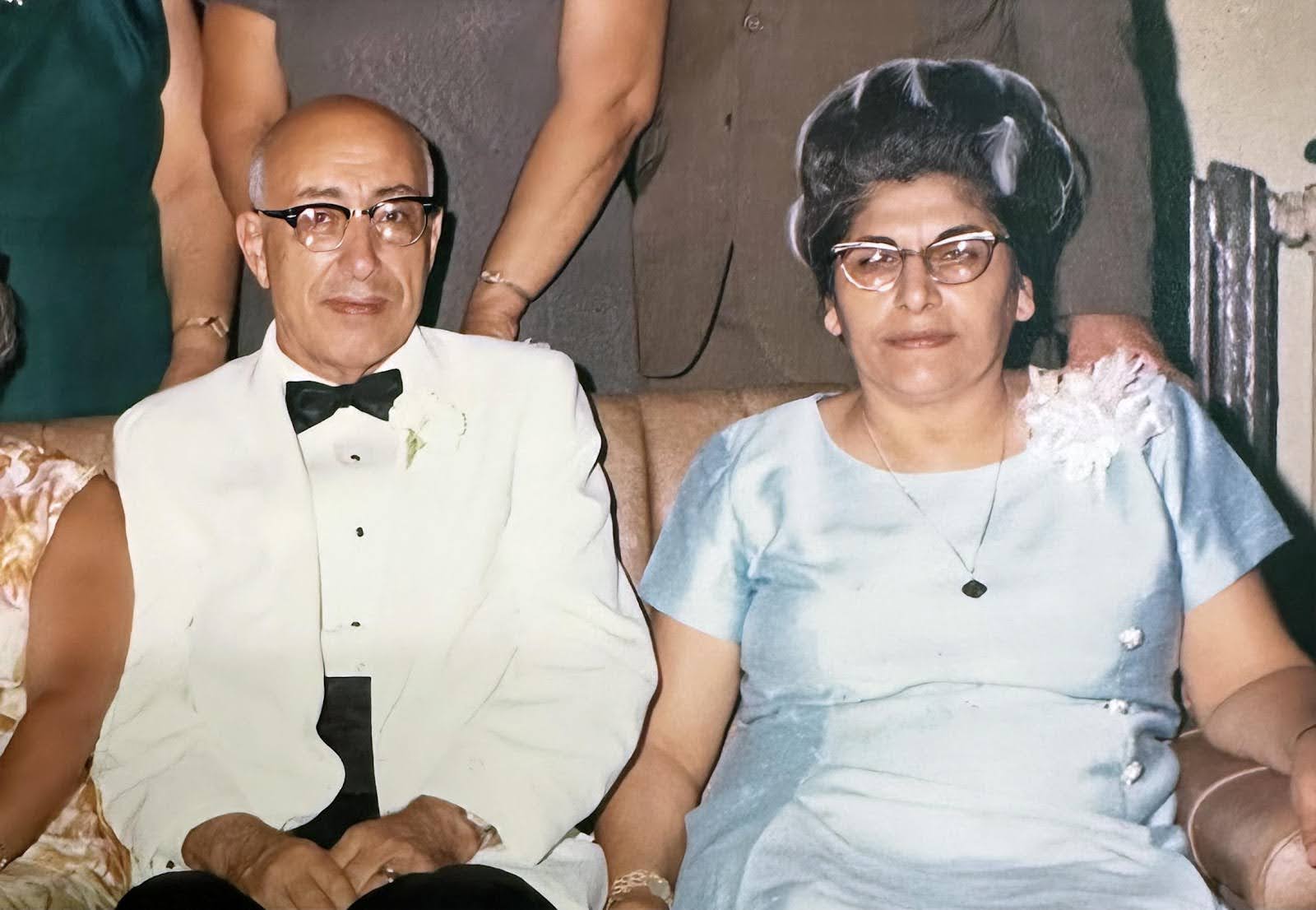
Richard Jabaley Sr. (1904-1981) and Minnie Boackle Jabaley (1911-1985)
Richard Jabaley Sr. managed his clothing and dry goods store at 105 Ocoee Street for thirty-seven years until his death in 1981. He and his wife Minnie both worked in the store; as their sons Richard Jr. and Ronnie grew older, they worked alongside their parents. A second-generation Lebanese American, Richard embodied the immigrant work ethic modeled by his father Solomen: long hours, honest dealing, and deep investment in the community he had chosen as home.
Minnie Boackle married Richard Sr. in 1933 and became his partner both in marriage and in business — working daily in the store at 105 Ocoee Street. She is remembered above all for her cooking: she alone made the dough for every meat pie at St. Catherine's annual Lebanese fundraising meal, using the same recipe she had learned and carried from Lebanon across an ocean. To those who knew her, this was more than cooking — it was, as those who remember her put it, "a genealogy of food, a way of passing down memory, care, and belonging."
When his father died in 1981, Richard Jr. returned home and took over operation of the store, running it until its closure in 1990. He and his wife Kathy had lived in one of the building's upstairs apartments from 1961 to 1972, raising their children in those high-ceilinged rooms above his family's store. In addition to shopkeeping, Richard Jr. maintained a photography studio in the building's smaller rear apartment, specializing in weddings, engagements, family portraits, and sports photography. He was a familiar fixture on the sidelines of high school football games, camera in hand. A charter parishioner of St. Catherine Labouré Catholic Church, 4th Degree Knight of Columbus, and inductee of the Fannin County Sports Hall of Fame, he was buried at Crestlawn Cemetery in Copperhill.
The Lebanese Community of the Copper Basin

Kathy and Richard Jabaley Jr.
From the corner of 105 Ocoee Street, looking up and to the right above the IGA grocery store, the top of a brick church comes into view. St. Catherine Labouré Catholic Church was where Copperhill’s Lebanese families gathered to worship — the Jabaleys, the Maloofs, the Shibleys, the Josephs, and the Isaacs. Richard Jr. served as an altar boy there, as did his male cousins, and later taught Sunday school to the congregation’s youth.
Lebanese immigrants to the Copper Basin worked hard to adapt to their new home. They sought to fit in, prosper, and belong. Young women wore American-style clothing. Families focused on learning English. Children attended public schools, and citizenship was embraced with pride. At home, however — in their kitchens — the aromas and flavors of Lebanon remained. Cinnamon, cumin, garlic, and spices filled the air. Food provided comfort and a thread of connection to a beloved homeland thousands of miles away.
Once a year, the women of St. Catherine’s shared that heritage with the broader community. The church’s annual fundraising meal became a beloved Copper Basin tradition, featuring dishes prepared from recipes traced directly to the villages of Lebanon — and in some cases, to the Ottoman Empire era. The women volunteered hundreds of hours: stringing bushels of local beans, preparing fillings, mixing spices, and baking desserts. On one occasion, the effort raised three thousand dollars for the church.
The lamb used in traditional Lebanese meat pies back home was costly and hard to find in Copperhill, so lean ground beef became the substitute — practical, accepted, and eventually beloved in its own right. Many of the women sold pies from their homes, and if you were fortunate enough to have a Lebanese friend in the Copper Basin, the pies often appeared without asking — wrapped and warm, shared as naturally as conversation.
In recent years, declining church membership has made such labor-intensive communal events impractical. But the tradition lives on in private. The children and grandchildren of these women continue to prepare traditional Lebanese dishes at large family gatherings — dozens of time-honored recipes appearing together, from entrées to desserts, filling the room with the same familiar aromas that once drifted from St. Catherine’s kitchen into the mountain air of Copperhill.
Fifty-One Years of Family, Then Transition
The Jabaley family owned 105 Ocoee Street for fifty-one years — from the building’s completion in 1947 until Richard Jr.’s sale of the property in 1998. In that half-century the building witnessed the full arc of Copperhill’s post-war story: boom, community life, industrial decline, flood, and reinvention.
The clothing store’s closure in 1990 was not a surprise: the decision had been made in early 1989, following the shutdown of the copper mining plant. A going-out-of-business sale was already underway when the catastrophic flood of February 1990 struck — floodwaters reaching eight feet in depth along Ocoee Street, inundating the building and much of the downtown. After extensive cleanup, Richard Jr. managed the building as a rental property for several years before finally selling.
Richard Sr. operated his ready-to-wear clothing and dry goods store on the ground floor for 37 years while managing upstairs tenants including dentists, a chiropractor, insurance agents, a music teacher, and his own family. He died in 1981.
Richard Jr. returned from the University of Georgia after his father's death and took over operation of the store. He also maintained a photography studio in the smaller rear apartment. The store closed in 1990 — a going-out-of-business sale was underway when the February 1990 flood struck. Richard Jr. then managed the building as a rental property.
Richard Jr. sold the building in 1998 to June Hyde and Myrna Ingram, who opened the Copper City Emporium: antiques, jewelry, dolls, and collectibles. When Myrna left the business in 2004, it transitioned to new management.
Following Myrna Ingram's departure, June Hyde and her husband Pat continued operating the space as A Country Lane, selling new furniture and home accessories.
Dellon Ash purchased the building in 2006 and continued it as a high-end furniture store, capitalizing on the growing tourism trade and interest in the historic downtown district.
A mountain outfitter occupied the space, serving the growing outdoor recreation market centered on the nearby Ocoee River and Cherokee National Forest — a fitting tenant for a building in the heart of Appalachian adventure country.
The brewery leaned into the building's unique geography, marketing itself as one of the only places in America where you could enjoy a craft beer while standing in two states simultaneously. It later relocated to 155 Ocoee Street with a riverfront view.
Following the brewery's departure, Copper Mine Candle Company moves in — the building's current tenant, keeping the historic corner alive with handcrafted candles celebrating the region's copper legacy.
Sources & References
- Jabaley, Richard J., Jr. Growing Up in Copperhill. 2009.
- “Richard Joseph Jabaley Obituary.” Cochran|McDaniel Funeral Homes, December 2023. https://www.cochranmcdaniel.com
- “Richard Joseph Jabaley Memorial.” Find a Grave, Memorial ID 262216317. https://www.findagrave.com/memorial/262216317
- “St. Catherine Labouré, Copperhill: An Interstate Congregation.” East Tennessee Catholic, September 2017. https://www.etcatholic.org
- “Acid Rain Devastates Tennessee’s Copper Basin.” Appalachian History, 2017. https://www.appalachianhistory.net
- “Copperhill Brewery.” https://www.copperhillbrewery.com
- “Copper Basin Mining History.” Telliquah.com. https://www.telliquah.com
About This Project
This historical documentation project was developed by the City of Copperhill in partnership with Discover Copper Basin, a 501(c)(3) nonprofit organization, with funding from the Tennessee Department of Economic and Community Development / Tennessee Downtowns Program. Content writing and research contributions by Steve Procko and Dr. Kathleen Thompson.