Marietta and North Georgia Railroad
- Home
- About Copperhill
- Historical Buildings & Landmarks
- Marietta and North Georgia Railroad
Step Inside History
The Marietta and North Georgia Railroad: The Hook and Eye Line
Whether you step off at the Blue Ridge Scenic Railway station on Toccoa Avenue or the Tennessee Valley Railroad on Jackson Street, the tracks beneath your feet tell a story that reaches back over 160 years to 1854.
The Marietta and North Georgia Railroad laid the iron foundations for what would become today’s heritage railways, though more than a century would pass before tourists would ride these rails for pleasure rather than commerce. The railway’s route, which spanned over 160 miles from Marietta, Georgia, to Knoxville, Tennessee, was a significant undertaking, with part of the route becoming famously known as the “Hook and Eye Line”.
Today, this historic corridor lives on through two distinguished heritage railways operating from opposite ends of the old M&NG route. In 2004, the Tennessee Valley Railroad Museum and the Tennessee Overhill Heritage Association partnered in acquiring part of the former Louisville & Nashville Hook and Eye line between Etowah and Copperhill, while on the Georgia side, the Blue Ridge Scenic Railway brought new life to the dormant tracks. Together, they preserve the engineering marvels that made this line legendary.
A Journey Through Time
1854-1870
The Dream Takes Shape
The M&NG's lineage began with the LHA Railroad, chartered in 1854. The pathway was first surveyed in 1858, but construction was halted by a lack of funds and the onset of the Civil War. The dream was revived after the war by William Phillips, a lawyer living in Marietta and a leading advocate for the railroad. He became the first president of the Marietta and North Georgia Railway Company in 1870.
1874-1890
Construction Through the Mountains
Despite selling railroad bonds, progress was slow, and construction did not begin until 1874, following the economic turmoil of the Panic of 1873. The railroad started as a narrow gauge line (three feet wide) out of Marietta, designed with the intention to convert to standard gauge in the future.
In 1880, Joseph Kinsey became the second M&NG president, bringing necessary capital to the project. He hired George R. Eager as the main contractor, who picked up the pace of construction, notably using leased prison labor.
A Colorful Legend
According to folklore, the "hook" curve was so sharp that railroad crews joked if the conductor's cigar went out in the caboose, he could wait until the train reached the horseshoe bend and lean out to get a light from the engineer.
The railroad's path significantly impacted the region, changing small towns forever and sometimes creating them from scratch. Blue Ridge, Georgia, was one such town, established on land owned by Colonel Mike McKinney, a leading advocate for the railway's path. The first locomotive arrived at the future town site in June 1886.
1890-1906
Triumph, Collapse, and Reinvention
The M&NG's converging lines finally met around Appalacia, Tennessee, in the Hiawassee Gorge on June 30, 1890, completing a connection that took 36 years to build and stretched approximately 207 miles. Despite this achievement, the railroad couldn't pay its debts, defaulting on bond payments in 1891, and was subsequently foreclosed upon in August 1895, selling for just 10 cents on the dollar.
After foreclosure, the railroad became the Atlanta, Knoxville, and Northern Railroad (AKN). Between 1902 and 1905, the Louisville and Nashville (L&N) Railroad acquired the AKN stock and successfully ran the line for 80 years.
Due to the extreme cost of operating the mountainous original M&NG route, the L&N completed a flatter and faster "New Line" in 1906, redirecting the main cargo traffic through Cartersville. The original M&NG route became known as the "Old Line" and served as a secondary main line.
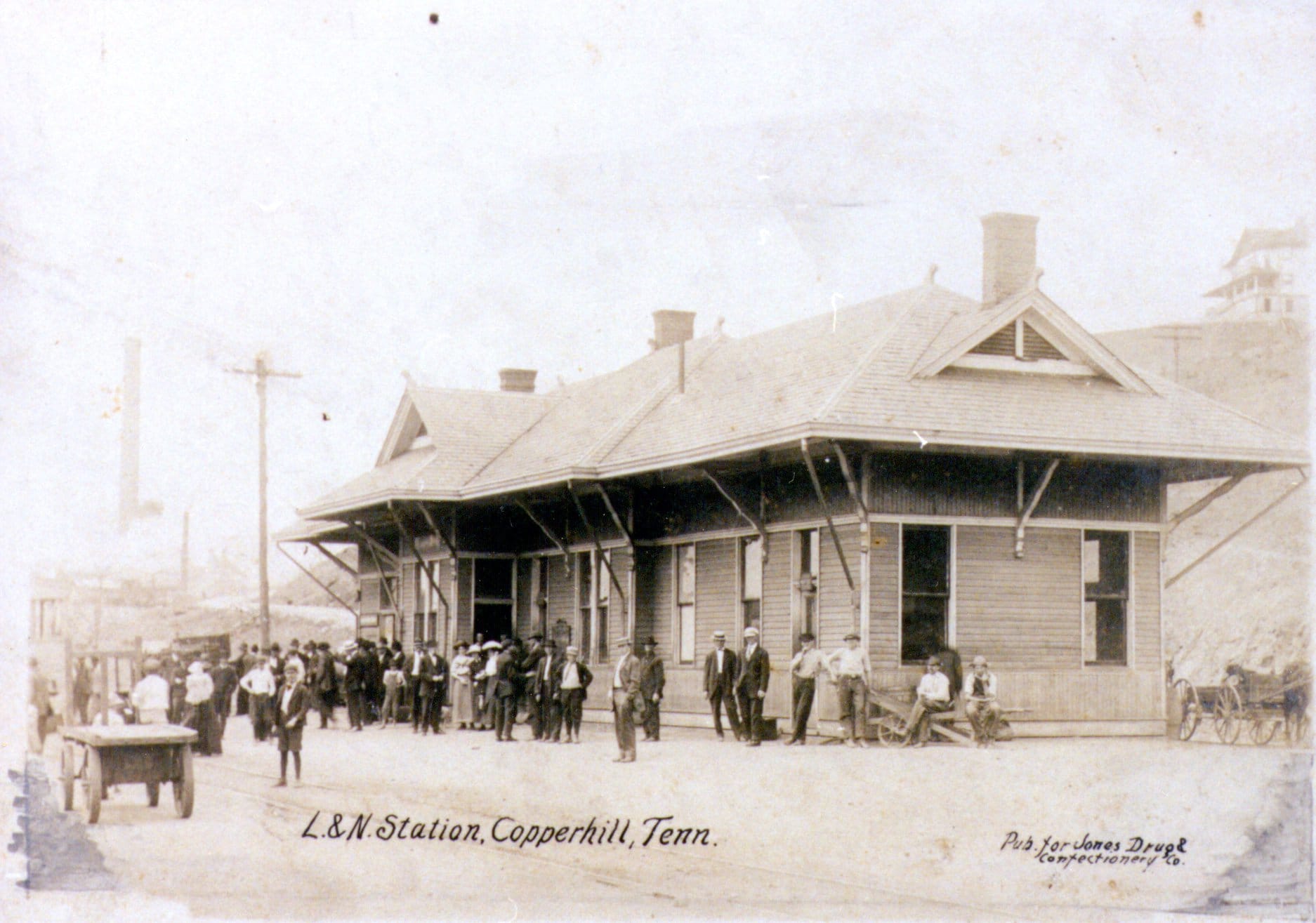
Copperhill Depot - built c. 1906-1907 by the L&N Railroad
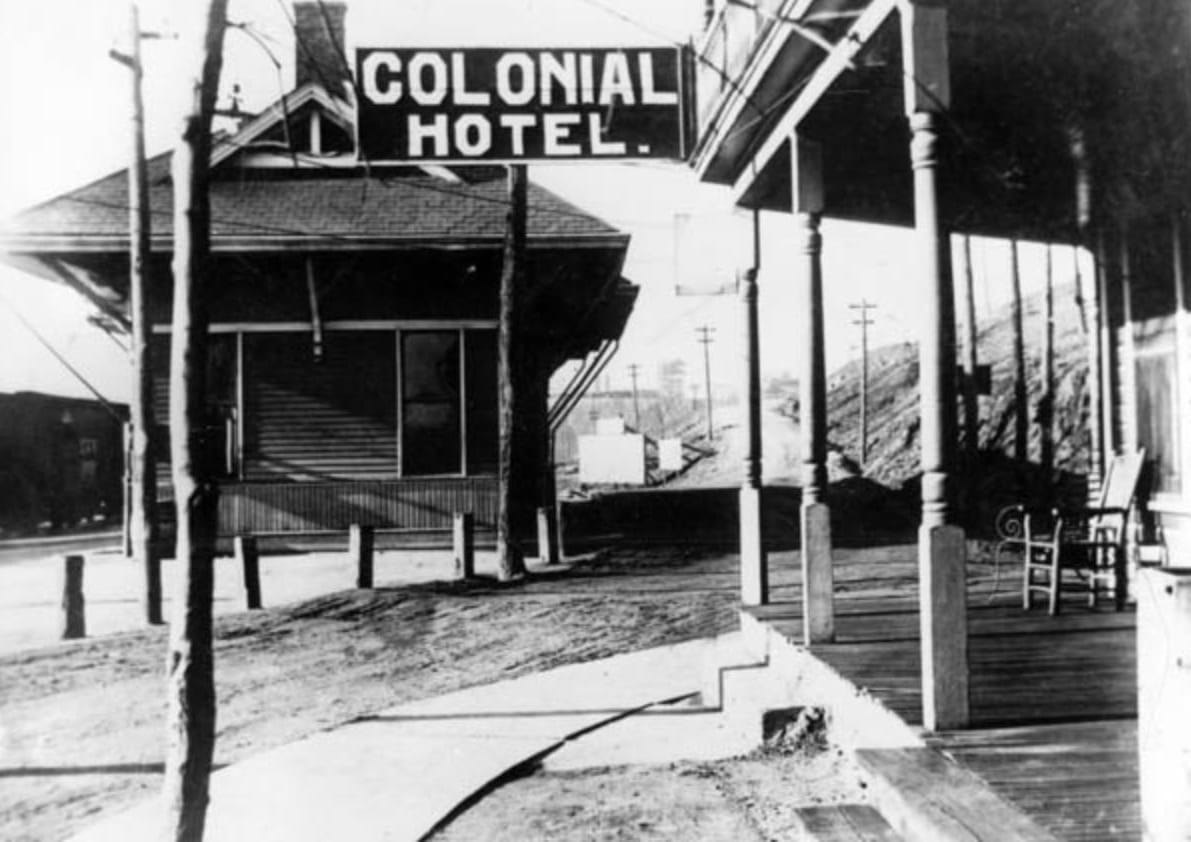
The Copperhill Depot as seen from the Colonial Hotel
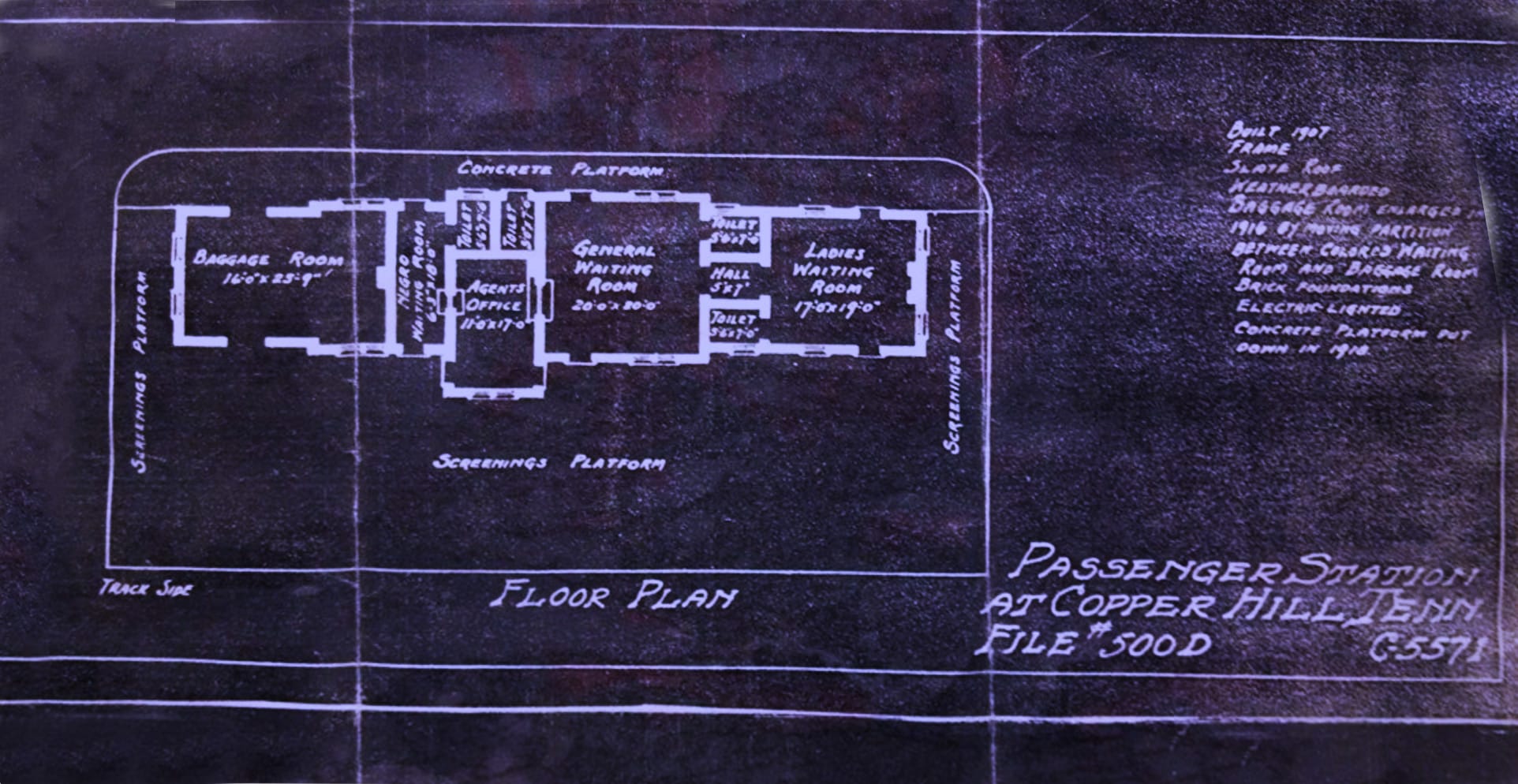
Blueprints of the Copperhill Depot
Engineering Marvels: "The Hook and Eye"
The M&NG's original mountainous line was nicknamed the "Hook and Eye Line" for two distinct features engineered to traverse the rough terrain.
Near Talking Rock, Georgia
This referred to a double reverse curve near Talking Rock, which included two switchback horseshoe bends designed to manage the steep grade at Tate Mountain. The curve slowed trains down and was eventually straightened in the 1950s. The "Hook" was eventually paved over when Highway 515 was built in Georgia, but its memory lives on in the railroad's legendary nickname.
The Hiwassee Loop - Near Farner, Tennessee
A major feat of engineering ingenuity built in 1898 to address a dangerously steep mountain grade. The area originally used a double switchback known as the "Old W," which was painstakingly slow. Thomas A. Aber designed a new route where the rail line makes almost two complete circles around Bald Knob.
This distinctive loop, sometimes allowing the engineer to see the back of his own train, is one of only 6 such loops in North America and the only one East of the Mississippi River. A 19-mile section of the line between the Historic District of Reliance and Farner, Tennessee, was placed on the National Register of Historic Places in 2007.
The train circles almost twice around Bald Knob, allowing the engineer to see the back of his own train
The Dark Years & Preservation Movement
1951-2004
Decline and Abandonment
The last passenger train departed Blue Ridge in 1951, and freight operations ceased in 1987. The line had been dormant since the 1960s, with decades of deterioration and uncertainty hanging over the historic route. What was once a vital economic lifeline now faced the possibility of being lost forever.
Georgia Side - Blue Ridge
The Volunteer Effort (1996-1997)
When Blue Ridge business interests approached railroad entrepreneur Wilds Pierce in 1996 about starting a tourist railroad, he said he only had operating rights to White Path—15 miles short of Blue Ridge.
Members of the Blue Ridge Mountains Preservation Foundation, North American Railcar Owners Association, and National Railway Historical Society took him at his word. Dozens of volunteers cut brush, cleared fallen trees, and repaired track for about six months, bringing the abandoned line back to life through sheer determination.
Tennessee Side - Etowah/Delano
Museum Expansion (1960-2004)
A small group of Chattanooga-area rail enthusiasts founded the Tennessee Valley Railroad Museum in 1961, with a mission to preserve, restore, and operate authentic railway equipment from the Golden Age of Railroading.
In 2004, TVRM and the Tennessee Overhill Heritage Association partnered in acquiring part of the former L&N Hook and Eye line between Etowah (Gee Creek, Tennessee) and Copperhill, extending their preservation mission to this legendary route.
The Heritage Railways Today
A Tale of Two Journeys Preserving One Historic Route
Blue Ridge Scenic Railway
Departing Blue Ridge, Georgia
The Journey
A 26-mile round trip from Blue Ridge to McCaysville, Georgia/Copperhill, Tennessee. After extensive volunteer restoration, the railway opened in 1998, bringing new life to the abandoned tracks.
During the first year of excursions, ridership reached more than 17,000 passengers. Today the railway hosts more than 78,000 passengers annually, making it a cornerstone of North Georgia tourism.
The Experience
- 🌲 Travels through the Chattahoochee National Forest
- 🏞️ Follows the winding Toccoa River
- ⏱️ 2-hour layover in the twin towns for shopping and dining
- 🎟️ Seasonal themed rides throughout the year
26
Miles Round Trip
78K+
Annual Riders
What Makes It Special
Accessible small-town charm starting in Blue Ridge, perfect for families and short getaways. Part of Georgia's scenic North Georgia Mountains tourism corridor with easy access from Atlanta (90 minutes).
Tennessee Valley Railroad Museum
Hiwassee River Rail Adventures from Delano, Tennessee
The Museum Legacy
Founded in 1960 and incorporated in 1961, the Tennessee Valley Railroad Museum originally stored equipment at the Western Union pole yard. Today it stands as one of America's premier operating railroad museums.
Two Journey Options
The Hiwassee Loop Excursion:
- 🚂 4.5-hour journey (1:30 PM - 6:00 PM)
- ⭕ 50-mile round trip featuring the remarkable Hiwassee Loop
- 🏔️ Climbs to the top where tracks cross over themselves
- 🎯 Continuous scenic journey with no layover
The Copperhill Special:
- 🚂 8-hour round-trip adventure
- 📍 94 miles through Hiwassee River Gorge
- 🔄 Passengers switch sides at midway point for complete views
- ⏱️ 90-minute layover in Copperhill/McCaysville
- 🔭 Dome car seating available for panoramic viewing
94
Miles (Copperhill)
1961
Museum Founded
What Makes It Special
Part of a comprehensive railroad museum experience with knowledgeable conductors providing continuous historical narration. The route includes travel along the famous Hiwassee Loop on the historic Louisville & Nashville Railroad's Atlanta Division, completed in the 1890s.
Meeting in the Middle
McCaysville, Georgia & Copperhill, Tennessee
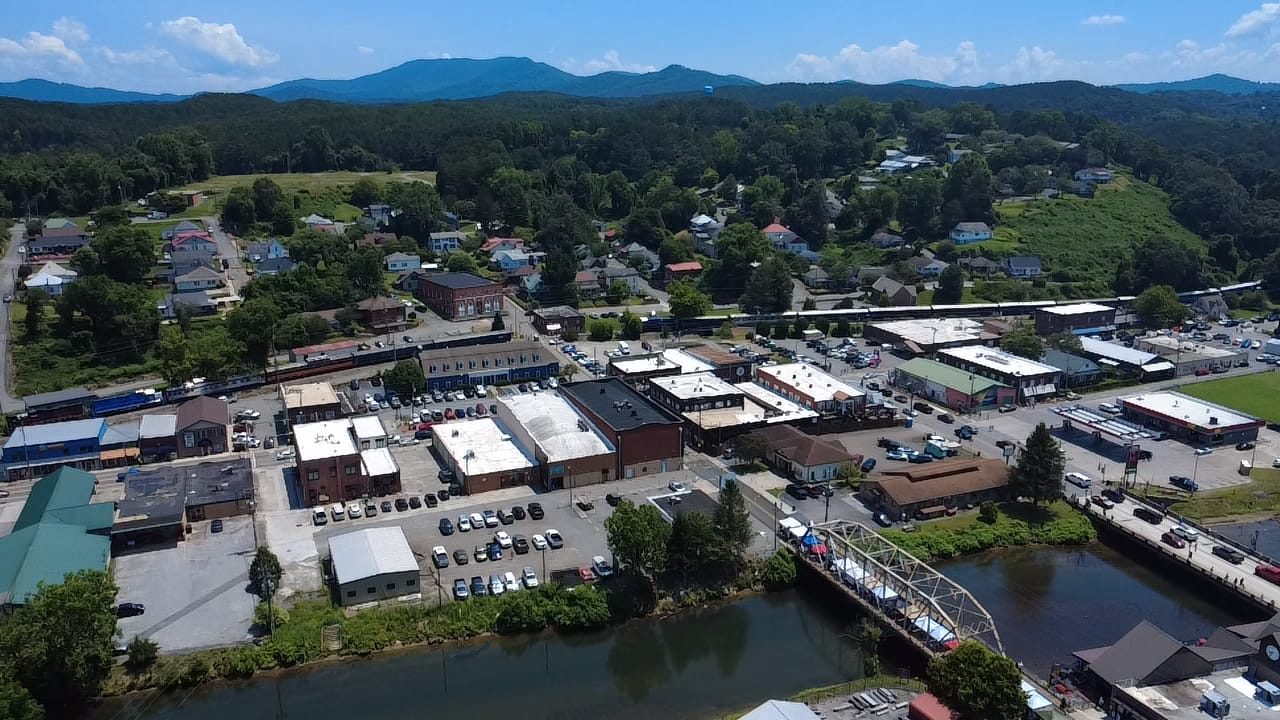
These unique border towns serve as the connection point for both railways, where passengers from north and south converge. The mining industry was the lifeblood of Copperhill and McCaysville, driving their growth and development. The extraction and processing of copper required extensive rail infrastructure, which facilitated the towns' expansion.
Today, visitors discover antique shops, local restaurants, galleries, and craft breweries. Passengers arriving from Blue Ridge have 2 hours to explore, while those arriving on the Copperhill Special have 90 minutes. The towns are compact and walkable—you can easily stand in two states at once!
The Legacy Lives On
More than a century after the Marietta and North Georgia Railroad first conquered these mountains, its “Old Line” serves a purpose its founders never imagined. What began as a commercial lifeline for marble, lumber, and copper has become a cultural treasure, preserved through the dedication of two remarkable heritage railways.
The Tennessee Valley Railroad Museum’s mission to preserve, restore, and operate authentic railway equipment on the Tennessee side, combined with the grassroots volunteer spirit that launched the Blue Ridge Scenic Railway on the Georgia side, ensures that the engineering triumphs and mountain grandeur of the Hook and Eye Line will inspire generations to come.
Whether you board at Blue Ridge or Delano, you're not just taking a train ride—you're experiencing a living monument to American ingenuity, community perseverance, and the enduring romance of the rails.
Sources & References
- Barclay, Robert E. The Copper Basin, 1890–1963. Knoxville, TN: Cole Printing and Thesis Service, 1975.
- Light, Edwin. Growing Up In The Colonial – A memoir by Edwin Light. 2021.
- There’s History Around Every Bend 11 – The Hook & Eye Line and Blue Ridge Scenic Railway. https://www.youtube.com/watch?v=WJeP_G0pbVE
- The Amazing Looping Railroad. https://www.youtube.com/watch?v=5V3oHAtfh3M
- Blue Ridge Scenic Railway Official Website. “History.” Blue Ridge Scenic Railway. https://brscenic.com/history/
- Tennessee Valley Railroad Museum Official Website. “About Us.” Tennessee Valley Railroad Museum. https://www.tvrail.com/about-us/
- Tennessee Valley Railroad Museum. “Delano Train Rides – Hiwassee Loop.” https://www.tvrail.com/train-rides/delano-train-rides/
- Tennessee Valley Railroad Museum. “Copperhill Train Ride: Scenic Tennessee Excursion.” November 14, 2024. https://www.tvrail.com/2024/11/14/copperhill-train-ride-scenic-tennessee-excursion/
- Tennessee Valley Railroad Museum. “Hiwassee Loop.” https://www.tvrail.com/train-rides/hiwassee-loop/
- Blue Ridge Ridge Magazine. “Blue Ridge Scenic Railway Feature.” 2024. https://www.bluetoad.com/publication/?i=810650&article_id=4698179&view=articleBrowser
- City of Etowah, Tennessee. “Hiwassee River Rail Adventure.” https://www.cityofetowahtn.com/2185/Hiwassee-River-Rail-Adventure
- Tennessee Overhill Heritage Association. “Excursions: Train & Railway Rides.” https://www.tennesseeoverhill.com/excursions/train-railway-rides/
- City of McCaysville, Georgia Official Website. “About McCaysville.” https://cityofmccaysvillega.gov/about-mccaysville/
- Blue Ridge Mountains Guide. “Copper Basin Historic Heritage Trail.” https://www.blueridgemountains.com/community/history/copper-basin-historic-heritage-trail/
- Blue Ridge Mountains Guide. “Secrets Just Over the Border.” https://www.blueridgemountains.com/blog/secrets-just-over-the-border/
- Georgia Come for Yourself. “Blue Ridge Train.” https://georgiacfy.com/blue-ridge-train/
- Georgia Mountains Guide. “Blue Ridge Scenic Railway.” https://gamountainsguide.com/blue-ridge-scenic-railway
- Only In Your State. “Hiwassee Loop Fall Foliage Train Ride Tennessee.” https://www.onlyinyourstate.com/experiences/tennessee/hiwassee-loop-fall-foliage-train-ride-tn
- Lake Chatuge Property. “Adventures: Blue Ridge Railway.” https://lakechatugeproperty.com/area-info/adventures/blue-ridge-railway.html
- Visitor Fun. “Tennessee Valley Railroad Hiwassee Profile.” https://visitorfun.com/destination/Tennessee/157/tennessee-valley-railroad-hiwassee/profile/14455
- North Georgia’s Two Shortline Railroads. Book website and historical resource. https://ngeorgiarr.com/
- Streamliner Memories. “Railroad History Blog – Hook and Eye Line.” https://streamlinermemories.info/?p=5852
- National Register of Historic Places. Historic district listing for 19-mile (20-mile) section of railroad corridor between Historic District of Reliance and Farner, Tennessee. Listed 2007. (Referenced via Tennessee Overhill Heritage Association)
About This Project
This historical documentation project was developed by the City of Copperhill in partnership with Discover Copper Basin, a 501(c)(3) nonprofit organization, with funding from the Tennessee Department of Economic and Community Development / Tennessee Downtowns Program. Content writing and research contributions by Steve Procko and Dr. Kathleen Thompson.
City Alerts & Notices
Unexpected closures, service disruptions, and important notices
160 Main Street
Copperhill, TN 37317
Copperhill, TN 37317
City Hall Hours:
Mon – Fri: 8 am – 4 pm